
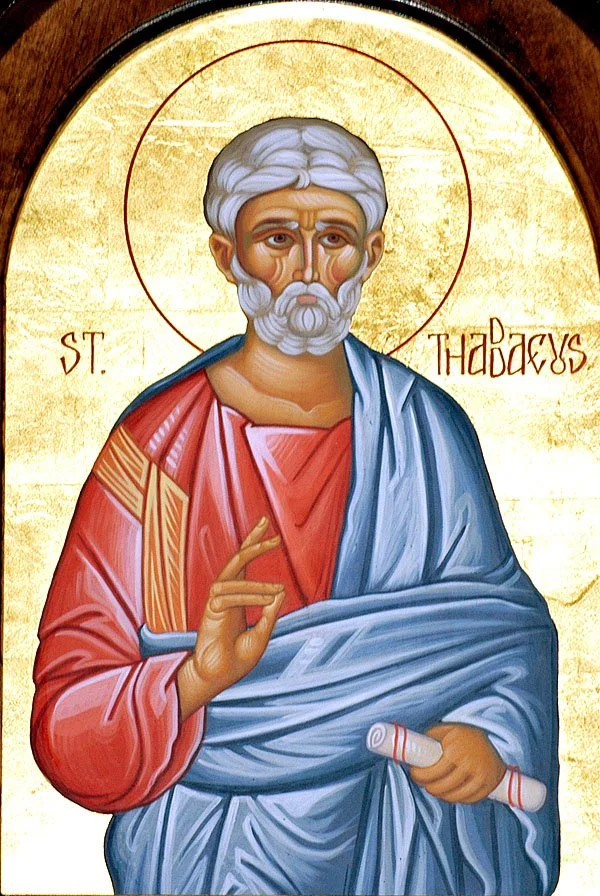
Saint Thaddeus the Apostle (also known as Saint Jude Thaddeus, Judas son of James, or simply Thaddeus) holds a special place of honor in our Holy Apostolic Catholic Assyrian Church of the East. As one of the Twelve Apostles chosen by our Lord Jesus Christ, he is a foundational figure in the apostolic succession that defines our ancient Church.
In the Holy Scriptures, Saint Thaddeus is listed among the Twelve (Matthew 10:3; Mark 3:18; Luke 6:16; Acts 1:13), distinguished from Judas Iscariot to avoid confusion. He is the apostle who, at the Last Supper, asked our Lord, "Lord, how is it that you will reveal yourself to us, and not to the world?" (John 14:22). A close relative of Jesus—traditionally a cousin or kinsman—and brother to Saint James the Less, he witnessed Christ's ministry, miracles, Passion, Resurrection, and Ascension. He also received the Holy Spirit at Pentecost and carried forth the Gospel with zeal.
Our Church proudly traces its origins directly to the apostolic labors of Saint Thomas, Saint Thaddeus, and Saint Bartholomew in the first century. Saint Thaddeus, often identified in Eastern tradition with Addai (the disciple sent to Edessa), preached boldly in Mesopotamia, Syria, Persia, and surrounding regions. His missionary work, alongside that of the other apostles, planted the seeds of Christianity in the Aramaic-speaking heartlands of the East, establishing communities that grew into the vibrant Church of the East. Blessed by Saint Peter himself at Babylon (1 Peter 5:13), our Church stands as one of the earliest and most enduring expressions of apostolic faith, independent and faithful through the centuries.
Tradition recounts that Saint Thaddeus evangelized far and wide, performing miracles, converting souls—including in the legendary mission to King Abgar of Edessa—and enduring persecution for the sake of Christ. He was martyred around AD 65–66, likely in Persia or Armenia, sealing his witness with his blood.
In our tradition, Saint Thaddeus is venerated as a pillar of the faith, remembered in our liturgies and commemorations. Sites associated with his memory, such as the historic Saint Thaddeus Monastery (Qara Kelisa) in northern Iran, continue to inspire pilgrims from our Church and sister traditions, honoring his enduring legacy.
Today, as the Assyrian Church of the East, we give thanks for Saint Thaddeus's courageous proclamation of the Gospel in these ancient lands. His example calls us to persevere in faith amid trials, just as he urged in the Epistle attributed to him (the Epistle of Jude), defending the truth and building up the Body of Christ.